

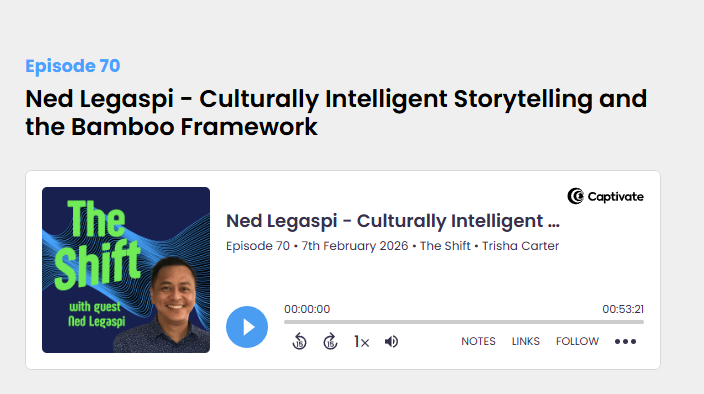
My first-ever podcast guesting became a 53-minute conversation with organizational psychologist Trisha Carter about culturally intelligent storytelling, cultural metacognition, and the Bamboo Framework.
On February 7, 2026, The Shift released Episode 70, “Ned Legaspi – Culturally Intelligent Storytelling and the Bamboo Framework.”
Hosted by organizational psychologist and cultural intelligence practitioner Trisha Carter, The Shift explores how people can become more aware of themselves and others, change perspective, and experience the shifts that come from deeper cross-cultural understanding.
Choose Where to Listen
The same full episode is available below on Apple Podcasts and Spotify. Visitors can use whichever platform they prefer without leaving this page.
Listen on Apple Podcasts
Listen on Spotify
Why This Conversation Was a First
This episode marked my first experience as a podcast guest. Unlike a short broadcast interview, the format allowed enough time to explain the ideas behind the book, trace the professional and academic journey that led to the framework, and reflect on how cultural assumptions shape both the stories we tell and the way audiences understand them.
A podcast creates room not only to introduce an idea, but to follow the thinking that gave rise to it.
What We Discussed
Our conversation moved across several connected themes:
- why stories are always shaped by culture, even when creators do not consciously recognize it;
- how cultural metacognition helps us examine the assumptions behind our own interpretations;
- why Southeast Asian stories do not need to be rewritten through Western narrative expectations;
- how the Bamboo Framework helps creators remain rooted while reaching audiences across cultures; and
- how communication becomes more intentional when we learn to anticipate differences in meaning.
Cultural Metacognition and Storytelling
One of the most important ideas in the episode was cultural metacognition: the ability to think about how culture influences our own thinking.
For storytellers, this means asking where our assumptions about conflict, character, emotion, family, authority, and resolution come from. It also means recognizing that audiences may interpret the same scene through a different cultural lens.
That awareness does not require a creator to dilute the story. It allows the creator to decide where context, explanation, or adaptation may help another audience connect without erasing the story’s identity.
The Bamboo Framework in Conversation
The podcast also gave me the opportunity to explain why bamboo became the central metaphor for the framework.
Bamboo is rooted, flexible, resilient, and capable of growing across many environments. Those qualities mirror the challenge faced by creators and communicators working across cultures: remain grounded, adapt with intention, and continue growing without losing the source of identity.
Why This Episode Matters to the Journey
Because this was my first podcast guesting, the episode occupies a special place in the public journey of the book and framework.
It was the first time the ideas were explored through a long-form audio conversation. It also opened a new channel for reaching listeners who may prefer to encounter complex ideas through dialogue rather than through a written article or formal presentation.
The conversation with Trisha Carter showed what podcasting can do particularly well: make room for curiosity, reflection, and the gradual unfolding of an idea.
Share This Story
Continue Exploring