

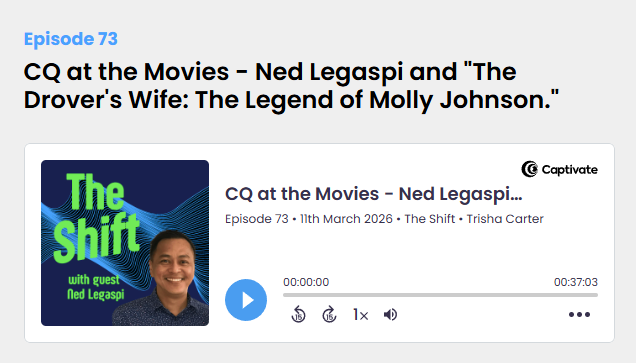
In my third and final guest appearance with Trisha Carter, we applied the CIS Bamboo Framework to the Australian film The Drover’s Wife: The Legend of Molly Johnson, examining how colonial history, Indigenous authorship, cultural intention, and audience interpretation shape the life of a story.
For this third instalment of CQ at the Movies, Trisha and I turned to an Australian film written and directed by Indigenous Australian artist Leah Purcell.
The Drover’s Wife: The Legend of Molly Johnson reworks a colonial-era story through a different cultural and historical lens. That made it a compelling case for exploring how stories change when authorship changes, when cultural context is restored, and when audiences encounter the work from outside its place of origin.
Choose Where to Listen
The full episode is available below on Apple Podcasts and Spotify. Use whichever platform you prefer without leaving this page.
Listen on Apple Podcasts
Listen on Spotify
A Story Rewritten from Within
One of the most important questions raised by the film is what happens when a familiar story is retold by someone whose cultural position has historically been pushed to the margins.
Leah Purcell does not merely modernize an older Australian story. She changes the center of interpretation. The retelling makes visible the Indigenous histories, gendered violence, and colonial power structures that earlier versions could leave peripheral or unspoken.
A retelling can do more than update a story. It can reveal which voices, histories, and meanings were absent from the earlier frame.
What We Explored
Through the CIS Bamboo Framework, our discussion examined:
- how settler-colonial history shapes the film’s StoryRoot;
- how Indigenous authorship changes narrative authority;
- how gender, violence, survival, and identity shape StoryCraft;
- how Australian and international audiences may interpret the same scenes differently;
- the gap between a storyteller’s intention and an audience’s reading; and
- what happens when a culturally specific story travels beyond its place of origin.
StoryRoot: Who Has the Right to Tell the Story?
StoryRoot asks us to look beneath plot and character toward the cultural ground from which the story grows.
In this film, that ground includes colonial Australia, Indigenous dispossession, racial hierarchy, gendered vulnerability, and the relationship between personal survival and national history.
The question is not only what story is being told, but who is doing the telling, from which position, and with what inherited authority.
StoryPulse: Intention Does Not Guarantee Interpretation
Cultural intelligence becomes especially useful when we examine the gap between what a storyteller intends and what an audience perceives.
Viewers from Australia may bring knowledge of local history, race, geography, and national mythology. International viewers may recognize some universal themes while missing cultural signals that shape the film’s deeper meaning.
That difference does not mean the film has failed. It reveals the work that interpretation requires when a story crosses cultural borders.
StoryLeaf: What Changes When the Film Travels?
StoryLeaf considers the wider life of the story after it leaves the creator’s hands.
A culturally rooted film may be reviewed, marketed, taught, or remembered differently across countries. Some audiences may focus on its Western genre elements. Others may see an Indigenous intervention in national memory. Still others may encounter it primarily as a story of motherhood, endurance, or violence.
The film’s journey therefore becomes part of the analysis. Its meaning is not fixed once and for all. It continues to be negotiated wherever the story is received.
Why This Episode Matters
This third conversation completed a progression across my guest appearances on The Shift.
- The first episode introduced culturally intelligent storytelling and the Bamboo Framework.
- The second applied the framework to a Thai film shaped by family, collectivism, and emotional restraint.
- This third episode applied it to an Australian film shaped by Indigenous authorship and settler-colonial history.
Together, the three episodes show that the CIS Bamboo Framework is not limited to one region, one genre, or one type of cultural conflict. It can support a deeper reading of how stories are rooted, crafted, interpreted, and carried into the world.
Episode giveaway
Trisha announced a giveaway of one copy of Culturally Intelligent Storytelling for Southeast Asian Creators. Listeners were invited to share the episode on LinkedIn or Facebook, tag Ned or Trisha, and name a movie or story that shifted their perspective. This note documents the original episode promotion and may be removed later if the giveaway has closed.
Share This Story
Continue Exploring