

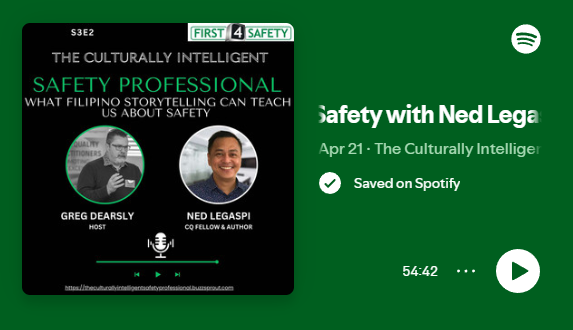
In conversation with safety professional Greg Dearsly, I explored how cultural intelligence shapes not only storytelling, but also how people experience work, authority, risk, responsibility, and care.
Greg Dearsly’s podcast, The Culturally Intelligent Safety Professional, examines what health and safety practice requires in multicultural organizations. In this episode, our conversation connected the CIS Bamboo Framework with the everyday realities of leadership, communication, and workplace safety.
We began with the question that shaped my work in culturally intelligent storytelling: Can stories truly resonate across cultures? From there, we moved into another question with immediate consequences for organizations: Can safety systems work if they do not account for the cultural meanings behind people’s behavior?
Choose Where to Listen
The full episode is available below on Apple Podcasts and Spotify. Use whichever platform you prefer without leaving this page.
Listen on Apple Podcasts
Listen on Spotify
From Storytelling to Safety
Stories move across cultures most effectively when they become more culturally grounded, not less. In the same way, safety communication becomes more effective when it understands the cultural logic behind people’s responses.
A rule may be clear in language but unclear in meaning. An employee may understand the instruction and still hesitate to challenge a supervisor, disclose uncertainty, or interrupt a risky decision. The problem may not be awareness. It may be hierarchy, face, belonging, trust, or the relational consequences of speaking.
If we are serious about safety, we must go beyond systems and compliance. We must understand people.
Key Ideas from the Conversation
Whether in storytelling or safety, culture shapes behavior, interpretation, trust, and the choices people believe are available to them.
In Filipino and other collectivist contexts, silence may express respect, care, uncertainty, or a desire to protect another person’s dignity.
The Filipino concept of kapwa, or shared identity, can shift the frame from “my safety” toward “our safety.”
Ideas such as bahala na are often reduced to fatalism, even when they may also express trust, faith, courage, or optimism.
In high power distance environments, workers may not openly challenge unsafe decisions. Leaders therefore carry a greater responsibility to ask, listen, and make dissent safe.
Procedures explain what to do. Stories can reveal why it matters, whose lives are affected, and what responsibility feels like in a community.
Silence, Respect, and Psychological Safety
In many workplaces, silence is quickly interpreted as agreement, understanding, or indifference. That assumption can become dangerous.
In cultures where hierarchy is respected and social harmony carries weight, speaking up may create risks beyond the immediate task. A worker may fear embarrassing a supervisor, disrupting the group, appearing disrespectful, or damaging a relationship on which future cooperation depends.
A culturally intelligent safety leader does not simply tell people to speak up. The leader creates conditions in which speaking becomes socially possible.
Kapwa and Shared Responsibility
Western safety language often emphasizes the individual: protect yourself, assess your risk, exercise your right to refuse unsafe work. These principles remain important, but they may not be the only route to engagement.
Kapwa, a Filipino concept of shared identity, offers a relational frame. Safety becomes not only an individual entitlement but also a responsibility toward people with whom one shares work, community, and consequence.
This creates another language for safety: I act carefully because your wellbeing is connected to mine.
Understanding Bahala Na Beyond Fatalism
Bahala na is often translated as “come what may” and treated as evidence of carelessness or fatalism. That reading is incomplete.
Depending on context, the phrase can express trust, spiritual surrender, courage under uncertainty, optimism, or the willingness to proceed when complete control is impossible.
Cultural intelligence does not romanticize risk. It prevents leaders from misdiagnosing the meaning behind behavior and responding with solutions that fail because they address the wrong problem.
Why Storytelling Belongs in Safety Practice
Safety systems require procedures, standards, and accountability. But rules alone do not always change behavior.
Stories help people see consequence, relationship, and responsibility. They translate abstract requirements into experiences that can be remembered and discussed. They can also create space for workers to share how risk actually appears in their own cultural and organizational context.
The difference between compliance and genuine care is often cultural. When safety communication understands that difference, it becomes more humane and more effective.
Share This Story
Continue Exploring