

Share This Story
My first European presentation was more than another point on a map. It was a reminder that Southeast Asian ideas belong in global conversations about culture, memory, identity, and storytelling.
When I first began asking how stories travel across cultures, I did not imagine that the question would eventually carry me to London.
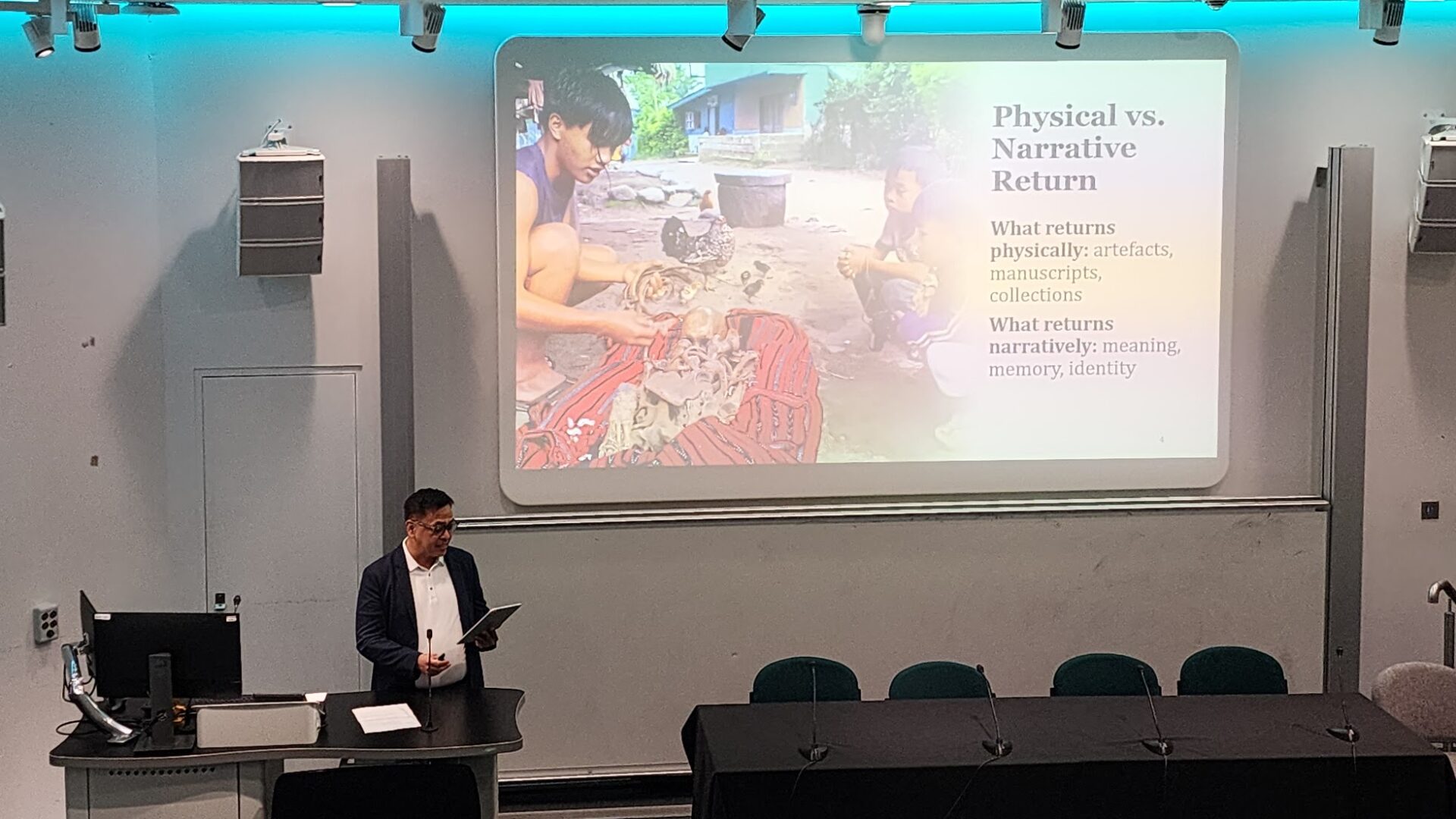
On September 20, 2025, I delivered my first European presentation at SOAS University of London. The venue was the Khalili Lecture Theatre in the Philips Main Building, but the moment felt larger than the room itself.
It marked the arrival of an idea that had been shaped in Southeast Asia and was now entering a conversation on another continent.
There was excitement, of course. There was also a quieter sense of responsibility. I was not simply bringing a presentation to London. I was carrying questions about whose stories travel, how they are interpreted, and what may be lost when cultural meaning crosses borders.
A milestone, but not an arrival
It is tempting to describe a first European presentation as an arrival. In one sense, it was. For a Filipino author and educator developing a framework around culturally intelligent storytelling, being invited to present at SOAS was deeply meaningful.
But the experience did not feel like a finish line. It felt like part of a longer movement of ideas.
The questions had already traveled through different rooms and cities. Each conversation had changed the way I understood them. Each audience had made visible another part of the challenge of communicating across cultures.
A Journey of Ideas
- ManilaWhere the questions took root
- HanoiA Southeast Asian conversation
- TokyoA wider Asian dialogue
- LondonThe first European presentation
Looking at that route, I was reminded that ideas do not become global simply because they reach more places. They become more useful when they can enter different contexts, meet new questions, and remain open to being examined.
A story does not become global by forgetting where it came from.
Crossing borders without losing roots
What stories carry with them
Stories do not travel alone. They carry histories, values, assumptions, identities, relationships, and ways of seeing the world.
When stories move quickly across platforms and borders, the visible parts may travel more easily than the cultural logic beneath them. Audiences may recognize the emotion while interpreting the meaning differently. A gesture of respect in one context may appear passive in another. A choice framed as personal freedom may be understood elsewhere as a rejection of family or community.
This is why cultural intelligence matters to storytelling. It asks creators to understand not only what a story says, but also the cultural world from which that story speaks.
- What cultural histories and values are carried by the story?
- Which meanings may be obvious to one audience but invisible to another?
- What can be explained without overexplaining the culture?
- What should remain rooted, even when adaptation becomes necessary?
These questions are not obstacles to creativity. They can deepen it. They help creators see cultural specificity not as a problem to remove, but as a source of texture, credibility, and emotional truth.
Why Southeast Asian voices matter
The presentation also affirmed something I have come to believe more strongly: Southeast Asian voices have much to contribute to global conversations about storytelling.
This does not mean there is one Southeast Asian voice or a single cultural perspective shared across the region. Southeast Asia contains many nations, languages, religions, histories, and social realities. Its value lies precisely in that complexity.
Global storytelling conversations have often been shaped by frameworks developed elsewhere. Those frameworks can be useful, but they do not always begin with the relational, historical, and cultural realities familiar to creators in this region.
Contributing a Southeast Asian perspective is therefore not about replacing one center with another. It is about widening the conversation and making space for more ways of understanding how stories are created, carried, and received.
Our stories do not need permission to enter global conversations. But they do need us to understand what makes them ours.
A Southeast Asian contribution
From recognition to responsibility
There is something affirming about seeing one’s work reach another continent. Yet recognition also creates responsibility.
It requires greater care in the claims we make, the communities we represent, and the differences we try to explain. Cultural intelligence should never become a shortcut for predicting people or turning cultures into neat categories.
Its more important contribution is humility. It reminds us that our own cultural lens is never the only one in the room, and that connection begins when we become curious about the meanings we do not immediately understand.
That was what made the moment at SOAS significant to me. The presentation crossed a continent, but the deeper work remained the same: listening, interpreting, and finding ways for stories to travel without leaving their roots behind.
The journey continues
From Manila to Hanoi, Tokyo to London, each stage has reinforced the same conviction: stories can create connection across cultures, but only when we take culture seriously.
My first European presentation was a milestone. It was also an invitation to continue developing the work, testing the ideas in new contexts, and learning from the people who encounter them.
The geography may keep expanding. The central question remains: how can stories cross borders without losing the cultural roots that give them meaning?
Engagement details
Editorial disclosure: This article was developed from Ned Legaspi’s professional experience and revised for publication with AI-assisted editing. The ideas, interpretations, experiences, and final approval are the author’s.
Share This Story