


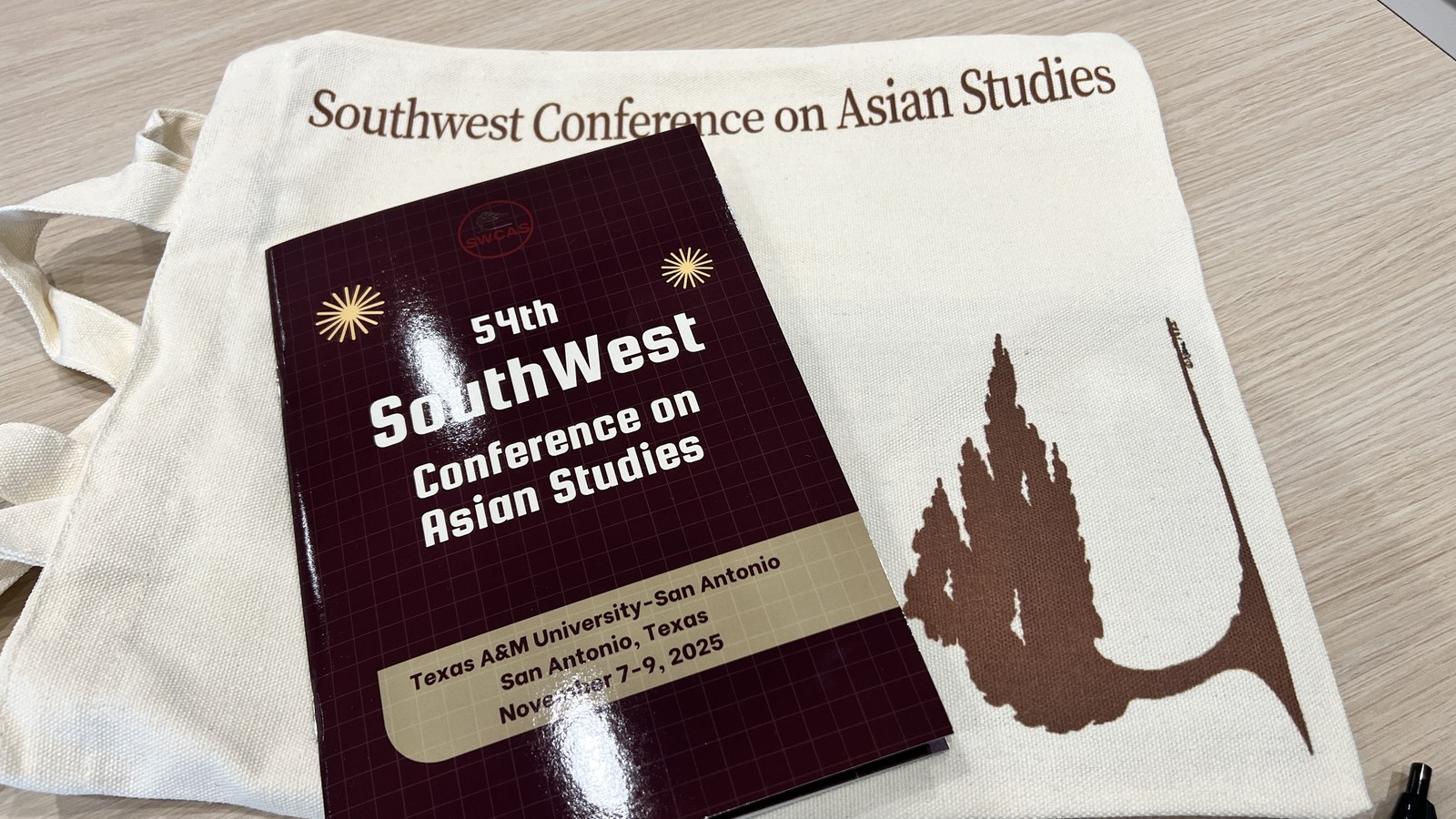
The paper was written in Manila. The SouthWest Conference on Asian Studies was in San Antonio, Texas. Almost nobody in that room worked on the Philippines.
On 8 November 2025 I presented “Rooted Yet Resonant: A Southeast Asian Framework for Culturally Intelligent Storytelling” at the 54th SouthWest Conference on Asian Studies, held at Texas A&M University-San Antonio.
SWCAS has been meeting since 1971, when the first conference was held in Austin. It is the Southwest regional affiliate of the Association for Asian Studies. So the address is regional, but the subject is not. The papers come from everywhere.
I was in Session 6.6, “Cultural and Literary Expression in Southeast Asia.” The chair was Min Suk Kim of the University of Texas at Austin.
Event Details
Conference: 54th SouthWest Conference on Asian Studies (SWCAS)
Dates: 7 to 9 November 2025
Venue: Texas A&M University-San Antonio, San Antonio, Texas
Ned’s session: Session 6.6, Saturday 8 November 2025, 1:45 to 3:00 PM, Classroom Hall 219
Panel: Cultural and Literary Expression in Southeast Asia
Chair: Min Suk Kim, University of Texas at Austin
Paper: “Rooted Yet Resonant: A Southeast Asian Framework for Culturally Intelligent Storytelling”
Why the room mattered
Two other papers shared my panel. Aanmona Priyadarshini of Southern Methodist University spoke on cultural resistance and the afterlife of rubble in post-conflict Asia. Then Karandeep Singh of the University of Hamburg spoke on cremation volumes as cultural knowledge systems in early twentieth-century Siam, the old name for Thailand.
So the panel ran across three countries and three centuries. That is the setting a framework has to survive.
A month before the SouthWest Conference on Asian Studies, I gave a version of this paper at the University of the Philippines Los Banos. That room was full of Filipino speech communication scholars. I could name a show, a network, a decade, and the audience filled in the rest.
San Antonio was different. Nothing about a Philippine example carries itself there.
The test at the SouthWest Conference on Asian Studies
That is the honest test of any framework. If it only works with an audience that already knows your country, it is not a framework. It is a shared memory.
So the Philippine material had to do two jobs at once. First, it had to stay specific enough to be true. Second, it had to travel far enough to be useful to someone working on Bangladesh or Thailand.
That is also what the CIS Bamboo Framework is for. Bamboo bends without breaking. A story can cross a border and keep its roots. But the person telling it has to know which parts are load-bearing and which parts are local decoration.
What I learned from the SouthWest Conference on Asian Studies is that a framework earns its name outside the culture that produced it. Inside your own country, agreement is cheap.
The Road Here
Five days after the book launched in California, the argument went back into an academic room, this time one with almost no Philippine specialists in it. San Antonio is where the framework had to work without any shared context to lean on.
Before this: the international book launch in Santa Monica, November 2025. · Next stop: MARAAS at the University of Pittsburgh, November 2025.
Related reading: Why Southeast Asian Stories Do Not Need to Sound Western and Rooted Yet Resonant: Stories That Travel Across Cultures.
If you want the whole method rather than one talk, start with the C3 Bamboo Framework. It is set out in full in the book.
Ned speaks to universities, newsrooms, and companies. See Speaking, or get in touch.