

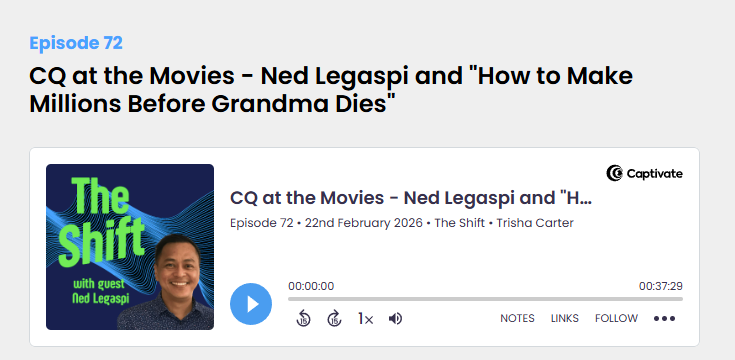
In this special episode of The Shift, Trisha Carter and I put the CIS Bamboo Framework to work by analyzing the Thai film How to Make Millions Before Grandma Dies through the lens of cultural intelligence.
Released on February 22, 2026, Episode 72 of The Shift became the first public demonstration of how the CIS Bamboo Framework could be used as an analytical lens for contemporary Southeast Asian cinema.
Rather than discussing the framework only in theory, organizational psychologist Trisha Carter and I applied it to one of the region’s most widely discussed recent films: the Thai sensation How to Make Millions Before Grandma Dies.
Choose Where to Listen
The full episode is available below on Apple Podcasts and Spotify. Use whichever platform you prefer without leaving this page.
Listen on Apple Podcasts
Listen on Spotify
Why This Film?
The Thai film moved audiences to tears across Southeast Asia while receiving a much quieter response in the United States. That contrast created an ideal case for examining how culture shapes both storytelling and audience interpretation.
The film’s emotional power comes from relationships, obligation, quiet gestures, family hierarchy, care for elders, and forms of gratitude that may be immediately legible to many Asian audiences but less visible to viewers working from a different cultural lens.
Emotional truth may be universal, but the way it is expressed and recognized is always culturally specific.
What We Discussed
Using the CIS Bamboo Framework, we explored the cultural dimensions woven through the story, including:
- collectivism and family responsibility;
- power distance across generations;
- indirect communication and emotional restraint;
- the Thai concept of Bun Khun;
- care for elders and intergenerational obligation; and
- why stories can cross borders without abandoning their cultural soul.
The CIS Bamboo Framework as a Film Lens
The conversation demonstrated how StoryRoot, StoryCraft, StoryPulse, and StoryLeaf can be used not only to create stories, but also to analyze how stories work.
StoryRoot helped us identify the cultural values and relationships that give the film its meaning. StoryCraft revealed how those values shaped character, conflict, pacing, and emotional expression. StoryPulse helped explain why different audiences might respond differently. StoryLeaf opened the question of how the film travelled across markets and entered wider cultural conversations.
Why This Episode Matters
This episode marks an important milestone in the public development of the CIS Bamboo Framework. Rather than introducing the framework conceptually, it demonstrates how the model can be applied to the analysis of contemporary Southeast Asian cinema.
It also expands the conversation around cultural intelligence beyond business and leadership, showing how CQ can deepen our understanding of storytelling, media, and cross-cultural audience engagement.
Share This Story
Continue Exploring