


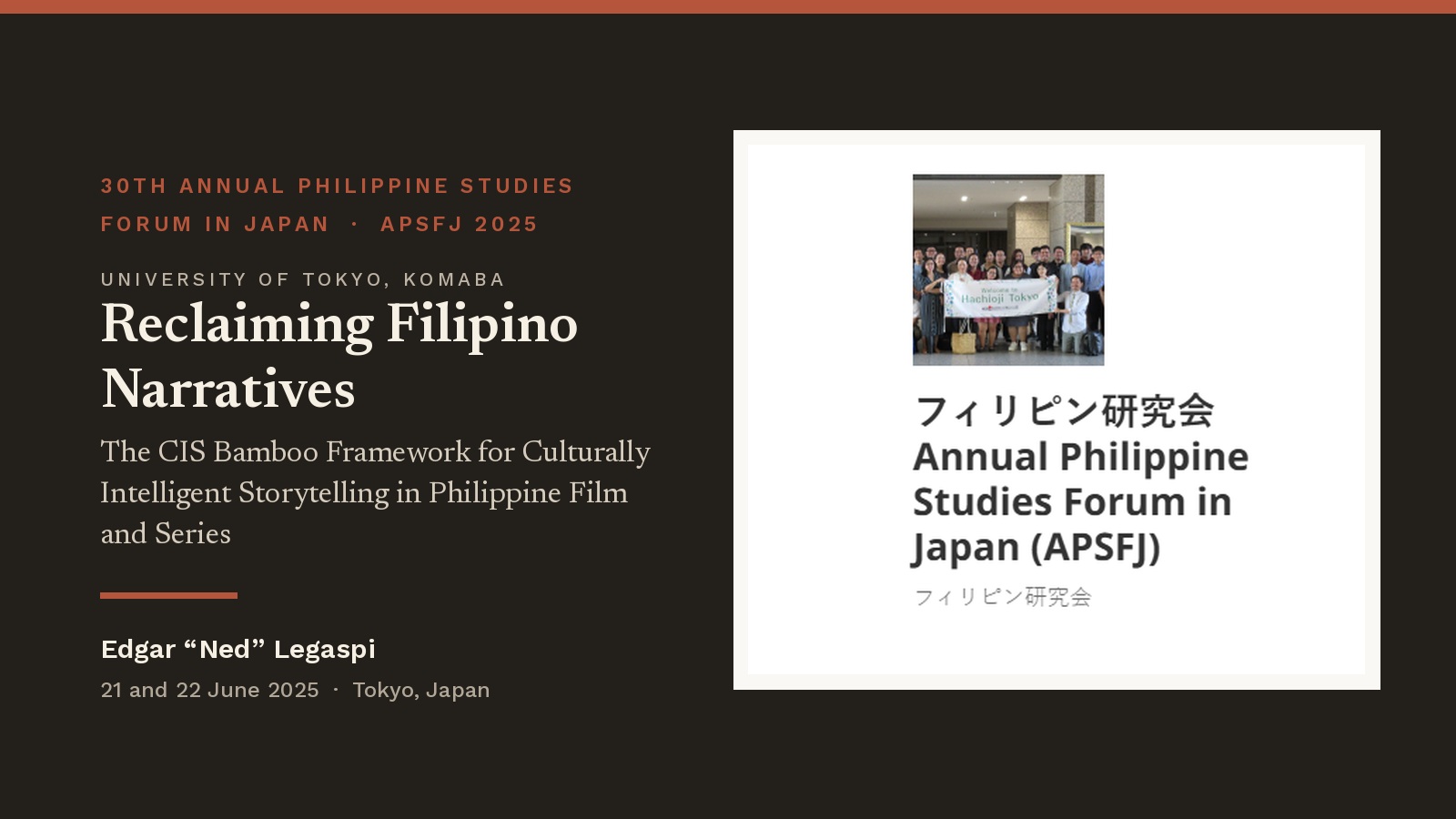
My first academic conference was in May, in Diliman. Three weeks later I was in Tokyo, at the Philippine Studies Forum in Japan. That one was my first outside the country.
It ran on 21 and 22 June 2025 at the Komaba Campus of the University of Tokyo. This was the thirtieth annual edition, and it drew Filipinists from Japan, the Philippines, and beyond. A Filipinist is a scholar whose field is the Philippines. Taihei Okada, a professor of area studies at the University of Tokyo, chaired the steering committee.
My paper was “Reclaiming Filipino Narratives: The CIS Bamboo Framework for Culturally Intelligent Storytelling in Philippine Film and Series.” I presented it in person.
Event Details
Forum
30th Annual Philippine Studies Forum in Japan, APSFJ 2025
Dates
21 and 22 June 2025
Venue
Komaba Campus, The University of Tokyo, Meguro, Tokyo
Steering committee chair
Taihei Okada, Professor, Department of Area Studies, Graduate School of Arts and Sciences, The University of Tokyo
Why film and series
In Diliman I had argued the framework in general terms. But in Tokyo I put it against actual Philippine film and television, because a framework that cannot read specific work is not a framework. It is a slogan.
Philippine series now travel on streaming platforms and reach viewers who have never set foot in the country. So the question I brought to the Philippine Studies Forum in Japan was simple. What survives the crossing, and what quietly gets dropped?
And the first word of the title carries weight. Reclaiming. Not adapting, not translating for a foreign buyer. The premise is that the narrative already belongs to us, so the work is holding on to it while the story travels.
Why the Philippine Studies Forum in Japan felt different
At home the audience shares the references. You can say the name of a show and the room already knows what you mean.
The Philippine Studies Forum in Japan was not that. The room held Japanese scholars who study the Philippines closely and Filipino researchers based in Japan. They know the material well, but many of them know it from outside daily Filipino life. That is exactly the gap the framework is about. So it was a fitting place for a first outing abroad. They could follow the argument without needing the shorthand.
After Tokyo the year kept moving. Diliman in May, Tokyo in June, then London in September, then Davao and Los Baños in October, then the book in Santa Monica in November.
The Road Here
Three weeks after Diliman the work left the country for the first time. The Philippine Studies Forum in Japan was the first room where nobody was obliged to care about a Philippine example, and that changed how much of the story I had to carry myself.
Before this: the UP Asian Center graduate conference, May 2025. · Next stop: the ACFEA conference in Hanoi, July 2025.
Related reading: Why Southeast Asian Stories Do Not Need to Sound Western and From UP to Southeast Asian Narratives.
If you want the whole method rather than one talk, start with the C3 Bamboo Framework. It is set out in full in the book.
Ned speaks to universities, newsrooms, and companies. See Speaking, or get in touch.