


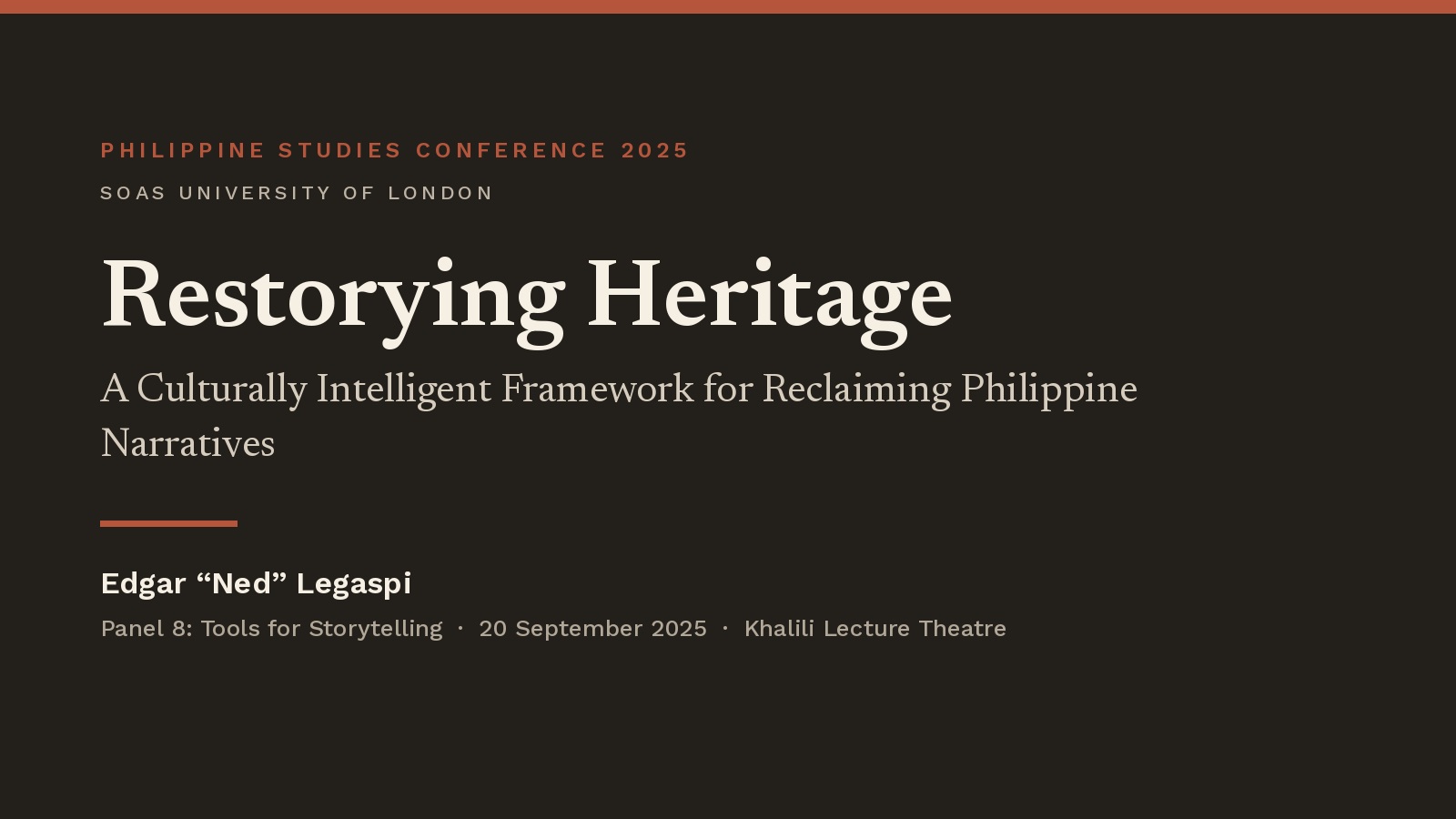
Most of the SOAS Philippine Studies Conference was about objects. Bells, coffins, arrowheads, gold. Things you can put in a crate and fly home. But my paper asked about something you cannot crate.
From 19 to 21 September 2025, I took part in the Philippine Studies Conference at SOAS University of London. SOAS is a British university that specialises in the study of Asia, Africa, and the Middle East. The conference was in its ninth year, and the 2025 theme was Repatriating Philippine Heritage. Also, the programme listed me as Edgar N. Legaspi.
My paper was called “Restorying Heritage: A Culturally Intelligent Framework for Reclaiming Philippine Narratives.” It ran on Saturday, 20 September, in Panel 8 of the SOAS Philippine Studies Conference, a session called Tools for Storytelling. I shared the panel with Reginald Zell, who spoke on reconnecting the Aeta with dispersed material culture, and with Francesca Inciong, Jude Crisostomo, and Farjina Razak, who presented Weaving Stories.
Event Details
Conference
Philippine Studies Conference 2025: Repatriating Philippine Heritage, 19 to 21 September 2025
Venue
Khalili Lecture Theatre, SOAS University of London
My session
Panel 8, Tools for Storytelling. Saturday, 20 September 2025, 5:00 to 6:30 PM
Programme
Full conference programme
What the paper argued
Repatriation usually means the return of things. A bell taken as a war trophy. A carved coffin sitting in a European storeroom. Those cases are real, and the conference gave them the attention they deserve.
That is the question I carried into the SOAS Philippine Studies Conference. But objects are not the only thing that leaves. Colonial rule, media globalisation, and migration also moved Filipino stories around, and they moved the right to tell them. So my paper argued that storytelling itself can be a form of return. Not as a figure of speech. As a practice.
So the paper introduced the Culturally Intelligent Storytelling Framework, then worked through cases from Philippine film, animation, and digital media. It also pushed back on export-driven storytelling, which strips local context out of a story so it will sell in more markets. That model treats heritage as raw material. Instead, the framework treats it as something living.
Why the SOAS Philippine Studies Conference mattered
This was two months before the book launched in Santa Monica, California, in November 2025. So the framework met its first hard audience in London, not in a bookshop.
Still, the room was not a media room. It held scholars, artists, community organisers, and museum professionals, people who spend their working lives on questions of return. Bringing a storytelling framework into that room meant it had to hold up next to hard cases about physical objects with paperwork and provenance behind them.
The Road Here
Europe for the first time. Four months after Diliman, the SOAS Philippine Studies Conference put the work in front of scholars who study the Philippines from the outside, in the city that holds a good deal of the material the paper was about.
Before this: the AUN-EEC conference at Ateneo, August 2025. · Next stop: the TFCN Global News Summit, the very next day.
Related reading from the SOAS Philippine Studies Conference and after: Crossing Continents with Stories at SOAS and Restorying Heritage: Returning Meaning, Memory, and Voice.
The argument I brought to London runs deeper than one session. If you want the whole method rather than one talk, start with the C3 Bamboo Framework. It is set out in full in the book.
Ned speaks to universities, newsrooms, and companies. See Speaking, or get in touch.