

Repatriation can return an object to its place of origin. Restorying asks whether meaning, memory, identity, and voice can return with it.
Heritage can be physically returned. But can the story surrounding it be returned as well?
I explored this question at the Annual Philippine Studies Conference 2025 at SOAS University of London, where scholars, researchers, cultural workers, and community advocates gathered to examine the repatriation of Philippine heritage across objects, archives, memory, and community life.
What does it mean to bring an object home when its meaning has long been named, classified, interpreted, and preserved by others?
My presentation, Restorying Heritage: A Culturally Intelligent Framework for Reclaiming Philippine Narratives, was part of the conference session on tools for storytelling.
I proposed that repatriation is not only about the physical return of artifacts, manuscripts, photographs, recordings, and collections. It is also about narrative return: restoring meaning, memory, identity, and voice to communities whose stories have often been interpreted through institutions, languages, and categories not of their own making.
Physical return and narrative return
The return of an object matters. It can correct a history of removal, reconnect a community with material heritage, and open new possibilities for research, education, ritual, and remembrance.
But an object does not return empty. It arrives with labels, catalog entries, scholarly interpretations, institutional histories, and assumptions about what it is and what it means.
Where the object goes
The movement of artifacts, records, images, and collections back to a country, institution, or community connected to their origin.
Who restores the meaning
The recovery of context, memory, identity, interpretation, and voice by the people whose lives and histories are carried by the object.
This distinction does not reduce repatriation to storytelling. Legal ownership, provenance, access, conservation, and institutional accountability remain essential. Narrative return adds another question: once heritage comes home, whose understanding of it will shape its next life?
Returning heritage is not only about bringing objects home. It is also about restoring meaning, memory, identity, and voice.
The work of narrative return
Why cultural intelligence matters
Drawing from the CIS Bamboo Framework, I explored how cultural intelligence can help people approach heritage narratives with greater awareness of context, identity, relationships, and differences in cultural perspective.
Museums, archives, researchers, and communities may not always begin with the same assumptions. They may understand ownership, authority, evidence, care, sacredness, access, and public knowledge differently.
Cultural intelligence does not resolve these differences automatically. It creates a discipline of attention. It asks us to notice the cultural standpoint from which a narrative is being told, the power attached to that standpoint, and the people who may have been excluded from the act of interpretation.
- Who named and classified the object?
- Whose memory was preserved, and whose memory was left outside the record?
- Who has the authority to explain what the object means?
- What relationships, rituals, or responsibilities are invisible in the catalog description?
- How might the community connected to the object tell its story differently?
These questions do not assume that communities speak with one voice. Communities contain different generations, interests, memories, and perspectives. Restorying is not the replacement of one official narrative with another. It is the opening of narrative space.
The bamboo as framework and metaphor
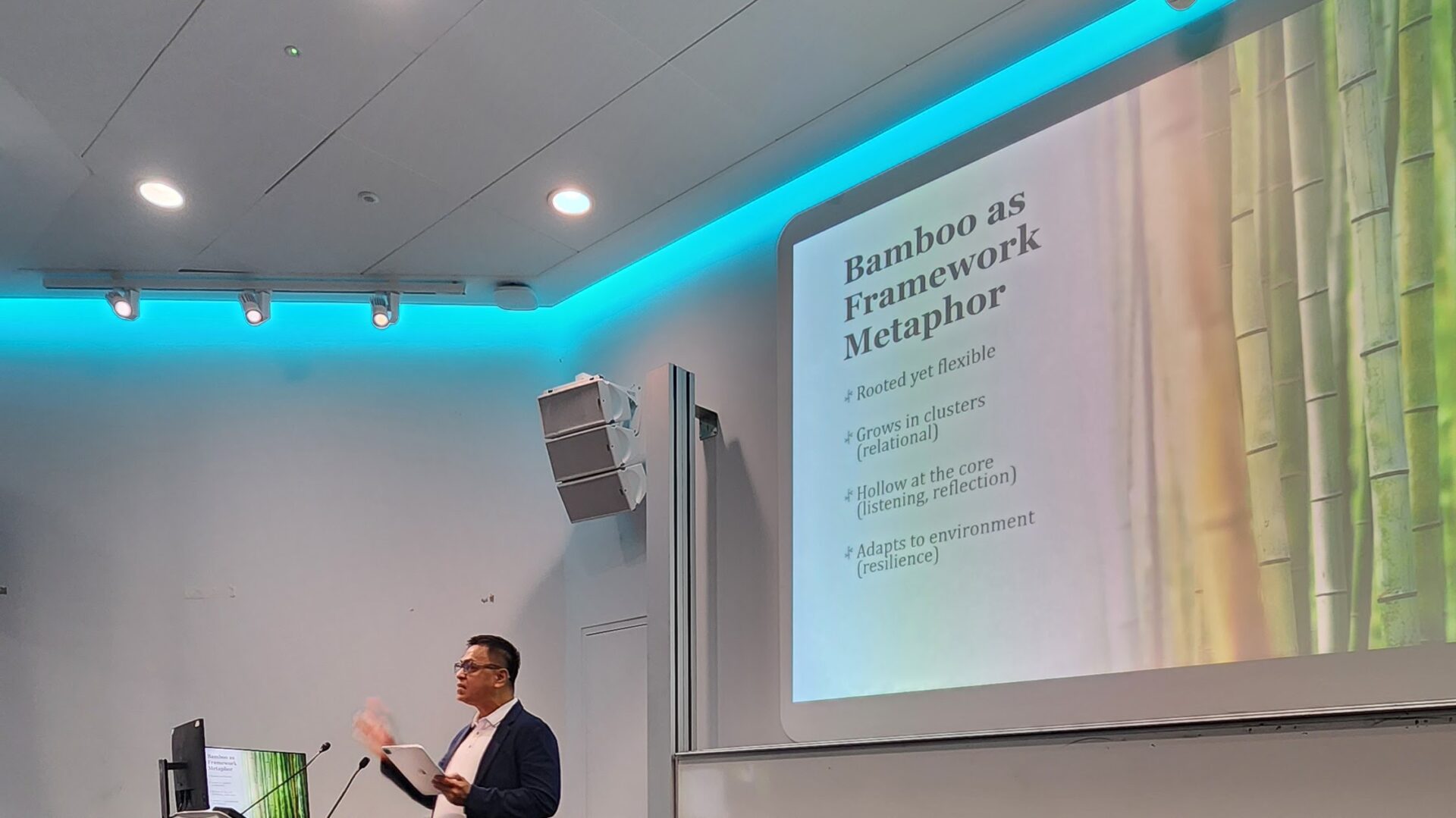
In the presentation, bamboo served not only as the name of the framework but also as a metaphor for cultural restoration.
The Bamboo Metaphor
Bamboo is rooted yet flexible. It grows relationally rather than in isolation. Its hollow center suggests openness, while its ability to bend reflects adaptation without the complete loss of form.
These qualities offer a way of thinking about heritage narratives. They must be rooted in history and community, but they must also remain open to dialogue, reinterpretation, and changing relationships across generations and institutions.
Flexibility does not mean forgetting where the story comes from. It means allowing the story to live again.
Restorying is not romanticizing
Reclaiming narrative should not be confused with producing a purified or idealized version of the past. Heritage can carry conflict, inequality, colonial encounter, internal difference, and painful memory.
A culturally intelligent approach does not erase these tensions. It makes room for them. It recognizes that restoring voice may also reveal competing voices and unresolved questions.
The goal is not to make the past comfortable. It is to make the work of interpretation more accountable, more relational, and more connected to the people whose histories are being represented.
An object may be returned once. Its story will continue to be negotiated.
Heritage as a living relationship
Why London mattered
Presenting this work in London was especially meaningful. The conference connected conversations about heritage held in museums and archives across borders with questions about the communities to whom these histories and objects remain deeply connected.
The setting made the central tension visible. Philippine heritage may be physically located far from the Philippines, yet it remains part of living relationships involving memory, identity, scholarship, institutions, descendants, and communities.
The experience reinforced an idea that continues to shape my work: reclaiming heritage is also an act of storytelling. Returning an object matters. But so does asking who gets to tell its story, from whose perspective, and for whom.
Engagement details
Editorial disclosure: This article was developed from Ned Legaspi’s conference presentation and professional experience, then revised for publication with AI-assisted editing. The ideas, interpretations, experiences, and final approval are the author’s.