

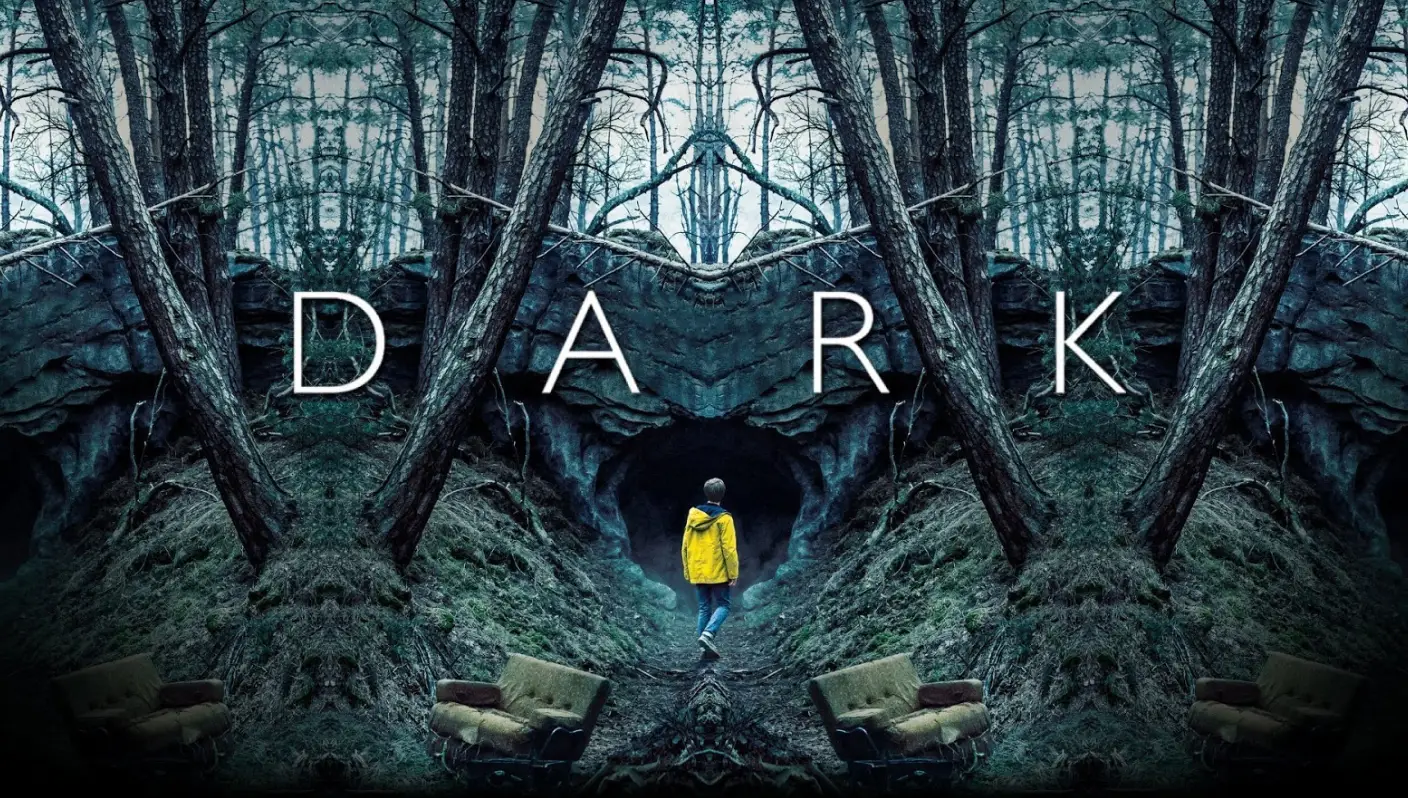
A slow, cerebral German-language series reached audiences around the world without simplifying its structure, accelerating its pace, or explaining every cultural and narrative cue.
Dark poses a useful challenge to a familiar assumption about global storytelling: that stories must become faster, louder, and easier to explain before they can travel.
The series does almost the opposite. It moves deliberately. It asks viewers to remember names, relationships, objects, dates, and events across several generations. Its emotional world is restrained, its atmosphere is severe, and its central mystery becomes more complex rather than less.
Yet audiences far beyond Germany followed it into the forests, caves, homes, and secrets of Winden.
The StoryCraft Question
How can a story remain culturally and stylistically specific while still creating enough emotional access to resonate across borders?
What appears on the surface
The surface of Dark is immediately distinctive. The German language remains central. The fictional town of Winden feels enclosed by forest, weather, infrastructure, and memory. Its visual design favors cold tones, symmetry, repetition, and controlled composition.
Winden as a closed world
The town is not a neutral setting. Its caves, homes, school, roads, and power plant create a tightly connected social and physical system.
Families across generations
Four families are linked through secrets, kinship, loss, responsibility, and consequences that move across time.
Stillness as tension
The series does not treat slowness as empty time. Silence, waiting, and observation become part of how suspense is built.
Repetition with variation
Images, names, spaces, and actions recur. The viewer learns to read patterns rather than wait only for exposition.
These elements make the series recognizable. But cultural intelligence asks us to move beyond what is visible and examine the deeper logic organizing the story.
What lies beneath the mystery
Beneath its science-fiction machinery, Dark is preoccupied with inheritance. History is not safely contained in the past. It enters family life, identity, guilt, obligation, and the choices people believe they are free to make.
The town seeks order while repeatedly encountering uncertainty. Families offer belonging, but they also become structures through which secrecy, shame, loyalty, and pain are transmitted. Characters try to protect the people they love, yet their efforts often reproduce the very conditions they hope to escape.
In Dark, history is not background. It is an active force inside the family.
The cultural logic beneath the plot
This is where the series becomes more than an intricate puzzle. The loops in time make visible something audiences can recognize even without sharing the same national context: the fear that we may inherit patterns we did not choose and pass them on despite our efforts to break them.
Reading cultural dimensions as story choices
Cultural dimensions can help identify patterns in the series, but they should be used carefully. The purpose is not to label Germany or treat every German story as culturally identical. The more useful question is how the series turns particular cultural tensions into narrative decisions.
Individual burden, collective consequence
Characters act from personal grief and desire, but their decisions reshape families and generations beyond themselves.
Knowledge becomes power
Status matters less than who understands the system, who controls information, and who can interpret what others cannot.
Chaos produces a search for structure
The story embraces ambiguity, while its characters repeatedly build maps, theories, rules, and explanations to contain it.
Information is withheld
Silence, secrecy, incomplete disclosure, and controlled revelation generate both emotional distance and narrative tension.
Pain is contained
Emotion is often carried through faces, pauses, physical distance, repeated actions, and atmosphere rather than extended verbal release.
Order bends under love and legacy
Characters appeal to systems and principles, then violate them when family, loss, or the hope of repair becomes more urgent.
The past remains present
Time is not simply a setting or device. It becomes the form through which inheritance, repetition, and consequence are understood.
A close community protects its surface
Winden appears orderly, but its stability depends on concealment, conformity, and the management of truths that could disturb the whole.
Why the story resonates beyond Germany
Most viewers have never lived in Winden, and few have experienced time as the characters do. The emotional pattern, however, is more familiar.
People understand the burden of family expectations, the fear of repeating the past, the desire to protect others through silence, and the frustration of discovering that knowledge does not always produce freedom.
The series creates access not by making those experiences generic, but by giving them a precise dramatic form. Time loops become a way of visualizing inherited pain. The mystery becomes a way of asking whether people can escape the systems that formed them.
The series stays strange, but its emotional problem is deeply recognizable.
Specific form, resonant pattern
This distinction matters. Global resonance does not require every audience to interpret every detail in exactly the same way. It requires enough emotional and narrative access for audiences to enter the story while allowing the story to remain culturally and stylistically itself.
Five StoryCraft lessons from Dark
- Let place shape the narrative. Winden is not decoration. Its physical and social enclosure determines what can be hidden, repeated, inherited, and discovered.
- Use pacing as meaning. Slowness is not simply a rhythm. It makes viewers experience waiting, uncertainty, observation, and the pressure of unresolved history.
- Anchor complexity in emotion. The structure may be intricate, but the audience follows grief, love, guilt, fear, and the desire to repair what has been broken.
- Trust the audience to participate. The series does not explain every connection immediately. It turns attention, memory, and interpretation into part of the viewing experience.
- Find universality through specificity. The story travels not because it becomes culturally neutral, but because its precise world carries an emotional pattern that audiences can recognize.
Dark’s Resonant Core
A story about whether people can escape what history has made of them.
Its cultural and stylistic specificity gives the question form. Its emotional truth allows the question to travel.
What this case study reveals
Dark does not prove that complexity, stillness, or cultural specificity will automatically produce global success. No framework can promise that.
What it demonstrates is another possibility. A story does not have to chase universality through speed, spectacle, or simplification. It can invite audiences into a demanding world when the world is coherent, the emotional stakes are legible, and the story trusts viewers to make connections.
That is the StoryCraft lesson at the center of this case: cultural rootedness and global resonance are not opposites. When story choices grow from a clear narrative logic, specificity can become the path through which connection happens.
Source note: This case study is adapted from Chapter 40 of Culturally Intelligent Storytelling for Southeast Asian Creators. It is a spoiler-light interpretive analysis of the series.
Editorial disclosure: This article was adapted from Ned Legaspi’s published work and revised for the C3 Journal with AI-assisted editing. The framework, analysis, interpretations, and final approval are the author’s.