
Share This Story
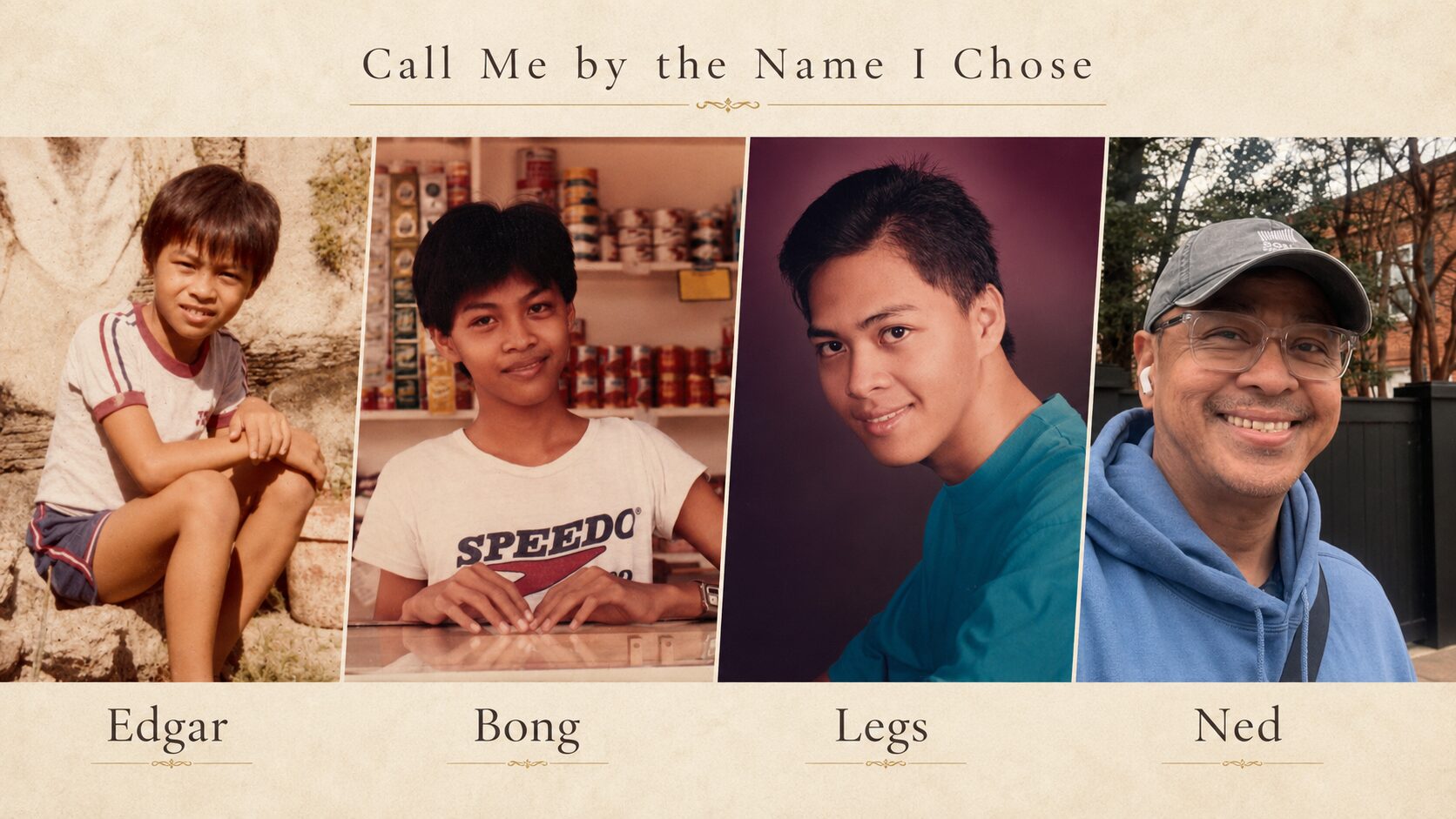
Edgar was the name given to me. Bong was the name of home. Legs was the name of belonging. Ned was the name I chose. None of the others disappeared.
You can usually tell which part of my life you belong to by what you call me.
If you call me Edgar, you probably knew me in elementary school, or you’re reading my name off an official document. If you call me Bong, you’re most likely family, a relative, someone from our old subdivision, or someone from church. If you call me Legs, chances are we went to high school together. And if you call me Ned, you belong to almost everything that came after.
Edgar, Bong, Legs, Ned. They’re not just different labels for the same person. Each one carries a specific time, a specific place, and a specific version of who I was when people used it. Put them together and you basically get a map of my life.
In This Essay
Four names, Edgar, Bong, Legs, and Ned, each one opening a different room in a life. One inherited surname, LEGASPI, carrying a history nobody chose. And a closing argument for holding inheritance and choice together, rather than picking one over the other, with a direct link to the C3 Framework and a question worth carrying into your own names.
Edgar: The Name Given to Me
My legal name is Edgar. I was named after Edgar Mortiz, a well-known Filipino actor and singer who was a major teen star the year I was born, 1971.
For the first several years of my life, Edgar was what people called me outside our home, in attendance in elementary school, on report cards, certificates, and anything that needed my official identity on it. After elementary school, though, it slowly disappeared from everyday conversation. These days almost nobody calls me Edgar unless they’re reading it off a form, checking my ID, or knew me from a very early chapter of my life. When someone calls out “Edgar” in a waiting room, it genuinely takes me a second to register that they mean me.
Edgar is legally still mine. It just isn’t really the name I recognize myself by anymore.
But it tells me something important about names: before we ever learn to introduce ourselves, someone else has already begun the story for us. A name can be a small record of the world into which a person was born, of what a family admired, remembered, hoped for, or simply liked at the time.
Bong: The Name of Home
At home I was Bong. My mother told me she named me after Bongbong Marcos, son of the Philippine president at the time, who many years later would become president of the Philippines himself and get called PBBM (President Bongbong Marcos). But inside our family the name never felt political. Bong just meant me. It’s what my parents called when food was ready, what relatives used at gatherings, how people in our subdivision, the residential neighborhood we lived in, and church knew me.
Even now, when someone calls me Bong, I immediately know something about how we’re connected. It’s familiarity. It belongs to people who knew me before the résumé, before any titles, before the book and the talks and the website, before I had accomplished anything that needed explaining.
Bong is the name of home. It carries childhood, family, faith, and the feeling of being known without having to introduce yourself. In a family, and perhaps especially in a relational culture like ours, identity is rarely just about the individual. You are also someone’s child, sibling, cousin, neighbor, classmate, churchmate. Hearing “Bong” reminds me that part of who I am has always lived in other people’s memories of me.
Legs: The Name of Belonging
When I got to Marist School, then a Catholic all-boys school in Metro Manila, I walked into a different naming culture entirely. The school is co-educational today, but in the years I was there, it was still an all-boys environment with its own particular rhythms, rituals, and ways of belonging. Students mostly called each other by surname, usually shortened into something you could shout across a corridor or a basketball court. Legaspi became Legs.
I’m sure other Legaspis somewhere got called that too, but in our batch, I was Legs. Nobody’s parent picked that name, and nobody wrote it on a document. It just came out of the group, the way most school nicknames do. Someone uses it once, other people repeat it, and eventually it’s part of the shared vocabulary.
Legs belonged to adolescence, to barkada, the Filipino word for your close circle of friends, to jokes, awkwardness, and figuring out where I fit among peers. The nickname mattered precisely because I had not invented it. It was given to me by people whose acceptance mattered to the boy I was becoming.
When someone calls me Legs today, I already know which door into my past just opened, and I’m bracing myself for an old classmate and an embarrassing story, probably both.
The Day I Found Ned
Sometime during high school I came across a book in the library called The Book of Names. Naturally I looked up Edgar. The entry said Edgar had a diminutive, Ned, and associated the name with riches and prosperity. I remember thinking, that sounds promising. Maybe calling myself that would turn into a kind of self-fulfilling prophecy.
I wasn’t making some deep statement about identity at that age. I just liked the name. It was short, distinctive, and came with a meaning I wanted to claim for myself.
I had already decided that when I got to college, I would introduce myself as Ned.
The Name I Chose
I’ve been going by Ned for close to forty years now. What started as a teenager’s experiment eventually became the name attached to nearly my entire adult life.
When I transferred to the University of the Philippines, the country’s national university, I stayed in communication, the field I had found instead of the pre-med track my mother had originally hoped I would take. I built a thirty-year career in international media, became an executive and creative leader, and for a long stretch was known as Sir Ned. In many Philippine workplaces, “Sir” and “Ma’am” are commonly used as respectful forms of address, especially for supervisors, teachers, and senior colleagues.
After I retired, I lost the professional identity I had spent decades building and had to figure out who I was without the company and the title that had defined me for so long. I went back to school. I became a Cultural Intelligence Fellow, joining an international community that applies cultural intelligence to different professional fields. I wrote a book, started teaching, and found myself speaking in classrooms, conference halls, hospitals, and embassies about culture and connection.
Maybe the prophecy did fulfill itself, just not exactly the way I pictured it as a teenager flipping through a library book. The riches weren’t only financial. They came as stories, people, places, lessons, and relationships. Prosperity turned out to mean getting to build something meaningful out of everything I’d lived and learned.
We Carry More Than One Self
People sometimes talk about identity like there has to be one true, authentic version of you hiding underneath all the others. I don’t really see Edgar, Bong, Legs, and Ned that way. None of them is fake. Each one simply emerged from a particular relationship and a particular world.
Edgar belongs to law, school records, and the identity I was first given. Bong belongs to family, home, and faith. Legs belongs to friendship, adolescence, and one specific school culture. Ned belongs to adulthood, choice, and the public life I eventually built.
Some people know your childhood self. Others remember you before you had any confidence. Some knew you when you were still trying to figure out where you belonged, and others only met you after you’d already learned how to tell your own story.
A name can work like a key. It gives someone access to a particular room in your life.
Reading a Name Is a Cultural Intelligence Skill
Every name in this story sits inside a culture. Edgar sits inside a generation that named its sons after matinee idols. Bong sits inside a family, a subdivision, a church. Legs sits inside one all-boys school and one batch of boys. Noticing that a name is never just a label, that it is a record of a specific world, is the first move of cultural intelligence.
Knowing the name is only half the skill. The other half is knowing which one belongs where. I don’t correct my mother when she calls me Bong, and I don’t expect a client to call me Legs. Reading the room before you open your mouth, choosing the register a relationship actually calls for, is communication practiced as a skill rather than left to instinct.
Underneath both is connection. A name someone chooses to use with you is a small, constant signal of how they see the relationship. This is the part of the C3 Framework I keep returning to in classrooms and workshops: culture gives us the material, communication gives us the judgment, and connection is what all of it is for. The fuller story of how that framework came together, from a question about storytelling to this wider architecture, is in From CIS Bamboo to C3.
Filipinos Rarely Leave a Name Alone
Filipinos have a genuinely playful relationship with names. We shorten them, stretch them, repeat syllables, mash them together, tack on unexpected endings, and end up with variations that only really make sense inside one family, friend group, or office.
Once people get comfortable with you, your name usually stops staying fixed. Ned alone has produced more variations than I can count at this point. There’s Neddy, softer and more affectionate. Nedsky, because adding -sky somehow makes any Filipino nickname sound more playful. And there’s Nedgar, a mashup of Ned and Edgar, the name I chose fused with the name I was given.
Each version carries its own tone, some affectionate, some teasing, some belonging to just one person or one group and sounding strange coming from anyone else. The freedom to play with someone’s name is usually a sign of familiarity. It says we know you well enough to call you something that has never once appeared on any official document.
The name may have started out as mine, but everyone around me has had a hand in reshaping it.
When Ned Became Nedlegs
By the early 2000s, Yahoo had become one of the main gateways to the internet. When I created an email address and online username, I decided to combine the name I had chosen, Ned, with Legs, the nickname my classmates had given me in high school.
That was how Nedlegs was born. At first, it was simply a practical digital identity. But the name eventually came to mean more.
Ned represented agency, the name I had chosen for myself. Legs represented belonging, the name other people had given me and kept alive through friendship. Put together, Nedlegs held both: the person I wanted to become and the communities that had already helped make me who I was.
Years later, when I finally built a company around the work and ideas I wanted to carry into the next chapter of my life, I used the same name: Nedlegs Incorporated. The business came much later. The name came first, out of a teenager’s choice and an old circle of friends.
There is an irony in that digital name that I only understand now. The early internet felt like a place where you could invent yourself almost from scratch. You could sit at a keyboard and decide what the world would call you. Yet even in the name I assembled for myself, something inherited had already slipped in. Legs came from Legaspi. Choice had carried history with it.
Why I Write LEGASPI in All Caps
There is one more detail in my name that people sometimes notice. In much of my public and professional work, I write it as Ned LEGASPI, with my surname in capital letters.
That habit began in 2006, when I started studying French. As I encountered more French names in books, lessons, correspondence, and conversations, I noticed that surnames were often written in capital letters. Some of my language partners in France explained that this made it easier to distinguish the family name from the given name, particularly because some names could plausibly function as either.
I liked the clarity of it. Eventually, I started writing my own surname the same way: LEGASPI.
But the longer I carried the name that way, the more complicated it became.
Whenever I traveled in Spain and registered at a hotel, something curious would often happen. A receptionist would look at my surname, look back at me, and tell me that they recognized it. In Spain, however, they knew it more commonly as Legazpi, with a z instead of an s. It was a small moment of recognition, almost always warm and friendly, yet it gradually began to carry another feeling for me too.
Legazpi is a municipality in Gipuzkoa, in the Basque Country of northern Spain. The name also carries an unmistakable connection to Philippine history. Miguel López de Legazpi, the Spanish navigator and colonial administrator who became the first Governor-General of the Philippines, was born in Zumarraga, also in Gipuzkoa. His surname would become deeply embedded in Philippine history and geography.
Five years after I began studying French, I started studying Spanish. By then, my own name had begun to feel like a small intersection of several cultural encounters: a Filipino surname with Spanish and Basque historical associations, a language connected to more than three centuries of colonial rule in the Philippines, and a typographic habit I had picked up while learning French.
Unlike Ned, I did not choose Legaspi. I inherited it.
I am careful not to treat a surname as proof of ancestry. Names travel in complicated ways, especially in countries shaped by colonization, and I do not know simply from carrying this surname exactly how it entered my own family history. But I also cannot pretend the historical resonance is not there. For a Filipino, Legaspi sits inside a much larger story of Spain and the Philippines, whether or not one’s own genealogy follows a straight line back to that history.
Ned is the name I chose. LEGASPI is the name I inherited. Putting them beside each other reminds me that identity is made from both agency and inheritance, from what we decide for ourselves and what history places in our hands.
That tension is not uniquely Filipino. Across a globalized world, many people live with names shaped by histories they did not choose. A reader in Colombia, Venezuela, Peru, or elsewhere in Latin America may recognize a related inheritance from centuries of Spanish rule, just as people in other post-colonial societies carry surnames, languages, and institutions marked by earlier empires. The histories are not identical, and neither are the ways those names entered individual families. But the question can feel familiar: what do we do with an identity that is genuinely ours and yet also carries the imprint of a history larger than ourselves?
For me, that question becomes especially visible when I put the two parts of my public name together. Ned points toward self-determination. I found it in a book, liked what it seemed to promise, and chose it for the person I hoped to become. LEGASPI points in the other direction, toward inheritance, family, geography, and a colonial past I had no role in creating. One looks forward. The other looks backward. Yet both belong to me now.
So what does it mean to write that inherited name in capital letters?
I don’t think of it as a grand act of reclaiming history, and I would be uncomfortable pretending that typography could undo colonial violence. For me, the gesture is quieter than that. Writing LEGASPI boldly makes me look at the name rather than treat it as neutral. It asks me to acknowledge the history without allowing that history to dictate the whole meaning of who I am.
Maybe this is one of the negotiations of living in a globalized world. We inherit names, languages, faiths, institutions, borders, and memories from histories that were already in motion long before we arrived. We do not get to choose all of them. But we do get to decide how consciously we carry them, what meanings we preserve, what meanings we question, and what new meanings we add through the lives we build.
What began for me as a French typographic convention has therefore become something more personal. I can choose the name through which I meet the world, while still acknowledging the histories that came to me unchosen. I do not have to erase one in order to honor the other.
Choosing Who We Will Become
Most of our earliest identities are simply handed to us. We inherit a name, a family, a language, a religion, a place in history, and a whole set of expectations before we’re old enough to choose any of it. As we get older, we start negotiating with what we’ve inherited, keeping some parts, reinterpreting others, leaving a few behind altogether.
Choosing the name Ned was a small act at the time, but looking back I can see that it carried something bigger. I wanted a hand in naming the person I was going to become. I didn’t want my identity decided entirely by what had already been assigned to me.
That never meant rejecting the people who raised me or the names through which they knew me. Ned didn’t erase Edgar or Bong or Legs. He carried all of them forward. Even LEGASPI, the surname I inherited rather than chose, travels with him.
Perhaps that is what choosing a self means in a globalized world. Not pretending that we can start from nothing, and not allowing inherited history to become destiny either. We carry what came before us, examine it, question it, sometimes reinterpret it, and then add something of our own.
Maybe identity is less about choosing between inheritance and reinvention than learning how to hold both. The names we are given tell us something about where we came from. The names we choose can tell us something about where we hope to go.
Keep Calling Me the Name You Know
And just to be clear, this isn’t a request for everyone who has known me by another name to start calling me Ned.
I still want my family and relatives to call me Bong, because that is the name they have always known at home. I still smile when my closest friends from elementary school call me Edgar, because that name belongs to the years we grew up together. And when high school friends still call me Legs, I hear all the familiarity and history that came with that name.
I don’t want those names replaced. I want them preserved.
If you paused on any of your own names while reading this, that pause is worth keeping. Whose name are you with family. Whose name are you when you walk into a classroom, a client meeting, a new country. What does each version of your name let people assume about you, and what does it protect.
That, after all, is part of the point of this story. Different names belong to different relationships, and each one carries a version of my life that I would never want to erase.
If you have always called me Edgar, Bong, or Legs, please don’t feel that you need to change. Those names tell me where we came from. Ned is simply the name through which many of the people I am meeting now will come to know me.
Maybe that is an appropriate place for this story to arrive. We meet one another carrying names we chose, names others gave us with affection, and names inherited from histories that began long before us. We cannot choose every part of that inheritance. But we can become more conscious of what we carry, and more deliberate about what we make of it.
So call me by the name you know.
And if we are only meeting now, welcome, Nedizen.
Where This Story Leads
If this reflection raised questions worth carrying further, the conversation continues in a few places. More reflections like this one live in the C3 Journal.
Every name in this essay led somewhere. These are a few of the places this one leads next.
Share This Story