
Share This Story
My mother wanted me to wear a white coat. Decades later, I began to understand that her dream was never only about a profession.
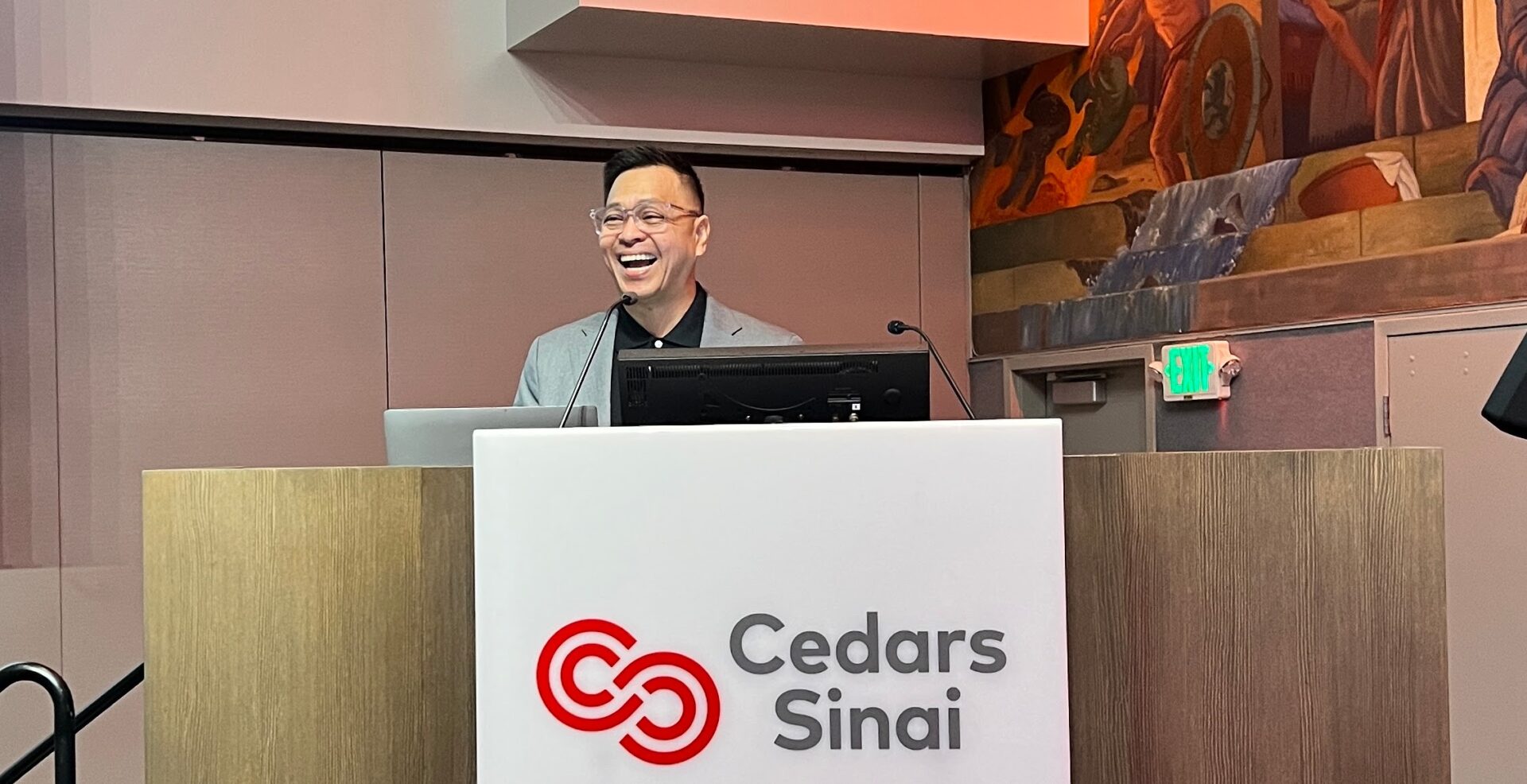
When I stood inside an auditorium at Cedars-Sinai in Los Angeles, I thought of my mother.
I was there to speak to healthcare professionals about cultural intelligence, communication styles, generational differences, and the ways people interpret care across cultures.
No white coat. No stethoscope. Just me behind a lectern talking about culture and connection. Still, somehow, I had found my way into a hospital.
My mother had always wanted that for me, though not quite in this form. She wanted me to become a doctor.
The dream she chose for me
My mother, whom I called Mader, had a simple dream for her only son. She wanted me to work in a hospital, preferably as a doctor, or at least as a nurse.
When I was sixteen, wanting to please her, I sat for pre-med entrance exams at four of the Philippines’ top universities, UP, UST, UE, and Centro Escolar. I failed every single one.
At that age, failure feels embarrassingly loud even when almost nobody knows about it. I knew what she had hoped for, and I knew I had not given it to her.
The truth was that I had never really felt pulled toward medicine. I was pulled toward stories, people, and the way media and communication shape how we see the world. I ended up in mass communication instead.
Mader was disappointed, I could tell. But she let me go anyway.
She quietly adjusted her dream to make room for mine.
A generosity I understood only much later
What it meant to be a good son
For most of my life, I had one basic goal: to be a good son to my parents. I am still not entirely sure I knew what that meant in practice.
Grades
Was being a good son about proving that their sacrifices had produced a capable child?
Stability
Did it mean building a career secure enough to protect the family from hardship?
Provision
Was love measured by the comfort and opportunities I could give them?
Pride
Did success mean becoming someone they could speak about proudly when relatives asked?
In many Filipino families, success is rarely treated as something that belongs to only one person. A child’s education, career, income, and reputation become part of the whole family story.
Parents sacrifice, and children grow up feeling that their achievements are supposed to return some of that sacrifice. We do not succeed only for ourselves. We succeed for the people who raised us too.
That can be a beautiful form of motivation. It can also make it difficult to separate what we want from what the people we love hoped for us.
I honestly do not know how much of my drive was ambition and how much was the desire to see my parents proud of me. Probably both, tangled together.
I worked hard. I built a career in international media and eventually became an executive, a decision-maker, someone people reported to. I was able to give my parents a comfortable life, and they never once demanded credit for any of it.
Work was never just work. It was one of the ways I knew how to say I love you.
Achievement as a language of care
February 25
My father died on January 16, 2020. He had been diagnosed with prostate cancer, though in the end it was not the cancer that took him. It was complications from diabetes.
My mother followed forty days later, on February 25, the same date as the EDSA People Power anniversary, the yearly commemoration of the 1986 peaceful uprising that ended the Marcos dictatorship.
I have never been able to separate those six weeks from everything that came after. Long before I stood behind a lectern at Cedars-Sinai, a hospital was already part of my story, not as an invitation, but as the place where I lost both my parents.
I knew, even before she was gone, that my mother wanted to follow my father. Some part of her had already decided. When she finally let go, that was the moment my own life truly went off course.
Every year, when people post about EDSA, freedom, and courage, I remember something much more private: a hospital hallway, a phone call, and the moment someone told me she was gone.
A death certificate can explain how someone died. It cannot explain who that person was.
Hers says acute hemorrhagic pancreatitis. It does not say she was patient, that she prayed for all of us every day, or that she held the family together quietly and never asked to be thanked.
It does not say she raised children, cooked, cleaned, worried about tuition money, and kept her faith even when life was genuinely hard.
There was no dramatic goodbye. I did not witness her last breath or hear any final words. There was only sudden silence and the disbelief that someone who had always been there could simply stop being there.
A few weeks later, the pandemic arrived. The country changed, the world changed, and my professional life began coming apart too. ABS-CBN, the Philippines’ largest broadcast network and the company I had worked for, went off air after Congress denied the renewal of its broadcast franchise, its legal permit to operate over the airwaves, and laid off thousands of us.
The year 2020 broke something in me. I entered one of the darkest periods of my life, dealt with depression, and eventually sought psychiatric help.
For the first time, I had to learn how to live in a world where both my parents were gone. I had spent decades trying to be a good son. I did not know who I was supposed to become once the two people whose approval mattered most were no longer around to give it.
When purpose disappears
Losing my parents changed my relationship with work. I still needed income. Grief does not pay the bills. But the reason behind earning it had quietly shifted.
I began asking questions I had avoided for years. Was I still working because I believed in the work, because I needed the security, or because I had simply lost the ability to imagine another life?
In 2023, after thirty years with the company, I took early retirement.
I wanted to reinvent myself, but reinvention did not arrive as a joyful transformation. It began with grief, regret, uncertainty, and the loss of a professional identity that had defined most of my adult life.
For decades, I had been Sir Ned. After retirement, there was no company, no title, and no structure telling me where I belonged.
I had lost the two people who gave my work much of its purpose. Then I lost the work that had helped me understand who I was. I had to look for meaning somewhere else.
Returning as a student
Somewhere between 2023 and 2025, something began to shift. I stopped asking who I was without the title and started asking what I actually had to say.
I returned to the University of the Philippines, the country’s national university, not as an executive or as someone people waited on for instructions, but as a student again.
I sat in classrooms. I read more than I had in years. I listened more than I spoke, which did not come naturally at first.
Slowly, I began finding a voice that was not the corporate voice I had built over thirty years and not the voice of a son still trying to prove that he had made his parents proud. It was beginning to be simply mine.
A Life in Returns
- Age 16Failed every pre-med entrance exam
- 2020Lost both parents and entered a period of grief
- 2023Retired after thirty years in international media
- 2025Completed PhD coursework and passed comprehensive exams
In 2025, I completed my PhD coursework and sat for the comprehensive exams in Philippine Studies, among the hardest examinations I have taken.
Thirty-seven years after failing every pre-med entrance exam, I passed my comprehensive exams, with a High Pass in one area.
I was not a doctor yet. Passing comprehensive exams does not complete a PhD. There is still a dissertation to write and defend.
But the milestone brought back a dream I thought I had left behind at sixteen. My mother wanted a doctor for a son. Maybe I was still becoming one, just not the kind she had originally imagined.
Finding my way into a hospital
Then came the invitation to speak at Cedars-Sinai.
I had spent decades working with stories instead of stethoscopes. I studied culture instead of medicine. I wrote a book about culturally intelligent storytelling and developed frameworks for how people make meaning across differences.
And there I was, inside an actual hospital, speaking to people whose work is centered on caring for others.
I did not become a medical doctor or a nurse. But I think I found a way to honor what was underneath my mother’s dream: care, service, and the desire to make someone else’s life a little better.
The white coat was one expression of service. It was never the only one.
A dream translated rather than abandoned
What culture teaches us to call success
Cultural frameworks remind us that success is not defined in the same way everywhere.
In achievement-oriented settings, people are often measured through visible accomplishment, education, profession, competition, and results. Certain careers become shorthand for success: doctor, lawyer, engineer.
The job stops being only a job. It begins to represent intelligence, stability, respectability, sacrifice, and upward mobility all at once.
In more relational cultures, success also belongs to the family. A child’s achievement becomes evidence that a parent’s sacrifices meant something. You carry not only your own ambition, but also your family’s history and expectations.
My mother’s wish for me came from that cultural world. It would be easy to interpret her dream as pure pressure, but that would be incomplete. It was also hope.
Security
A profession that could protect me from the hardships she had known.
Dignity
A life that would be respected and recognized by the wider community.
Usefulness
Work through which I could care for people and contribute something of value.
Continuity
Evidence that the family’s sacrifices had opened a better path for the next generation.
The problem was never that she dreamed too much for me. The problem was that when I was young, I understood the dream too literally.
You can carry someone’s values without copying every detail of their plan.
The lesson that took decades to learn
Translating a parent’s dream
Culture does not only tell us what to do. It also gives us the symbols through which we express love, responsibility, fear, and hope.
For my mother, doctor was the symbol of a good life. For me, stories became another way to serve. Teaching became another way to care. Writing became another way to help people understand one another.
Cultural intelligence asks us to look beneath visible behavior and search for the meaning underneath it. The same approach can help us understand what our parents want for us.
These are the questions I eventually learned to ask about my mother’s dream. They are worth asking about any expectation still living in your own life, whoever it came from.
- What is the expectation trying to protect?
- What fear is hidden beneath the instruction?
- What hope is the parent trying to pass on?
- Which value can be honored even when the original plan changes?
When I looked beneath my mother’s wish for a doctor, what I found was not really a job title. It was her desire for me to live a meaningful life.
That is a dream I can still keep.
Becoming a good son differently
My mother did not live to see me complete my PhD coursework, pass my comprehensive exams, publish my book, teach at a university, or speak to healthcare professionals at Cedars-Sinai.
I wish she had.
But grief has taught me that love does not disappear when someone dies. It changes shape. You learn to carry it differently.
I no longer spend my life chasing my parents’ approval, but I still feel their values guiding many of my choices.
I miss them. I am grateful to them. And I hope, wherever they are, they can see that the path I chose was not a rejection of what they wanted for me.
It was my attempt to translate their hopes into a life I could honestly live.
The Life I Am Still Becoming
I did not become the doctor my mother imagined.
I am still becoming a different kind of doctor. More than that, I am still learning how to become the son she raised.
Editorial disclosure: This personal essay was written from Ned Legaspi’s lived experience and revised for publication with AI-assisted editing. The memories, interpretations, reflections, and final approval are the author’s.
Share This Story