


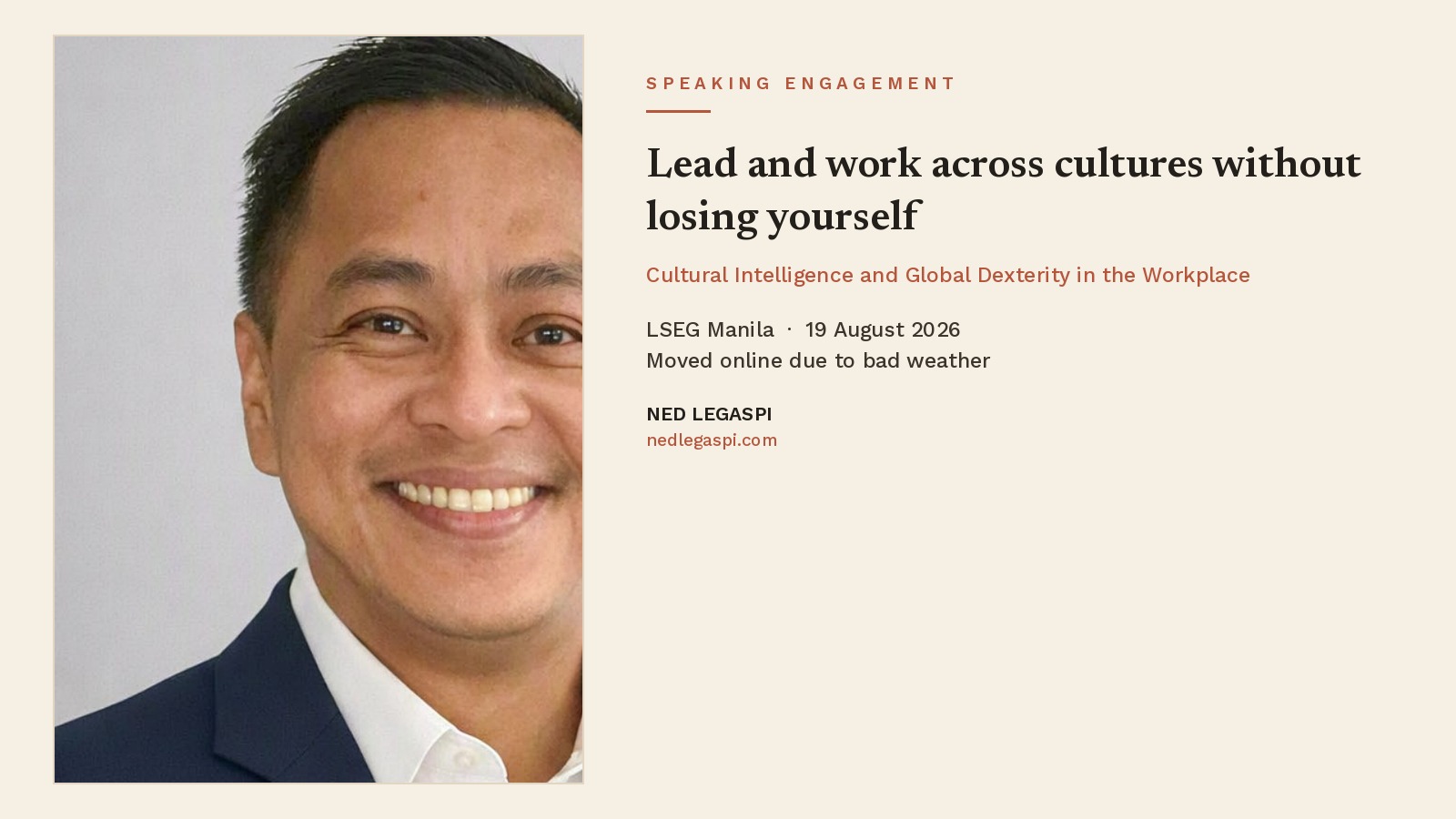
The LSEG Manila talk was called “Lead and work across cultures without losing yourself.” Then the weather moved the room.
On 19 August 2026 I spoke to the team at LSEG Manila, from 3:30 to 5:00 in the afternoon. LSEG is the London Stock Exchange Group. Its Manila office sits in Citi Plaza in Bonifacio Global City, Taguig, and runs across four and a half floors.
The session was booked as a face to face talk in that office. Bad weather changed that. So we ran it online instead.
Event Details
Talk: “Lead and work across cultures without losing yourself”
Theme: Cultural intelligence and global dexterity in the workplace
Host: LSEG (London Stock Exchange Group), Manila office
Date: Wednesday, 19 August 2026
Time: 3:30 to 5:00 PM
Original venue: 9F to 14F, Citi Plaza, W. North, 34th Street, Bonifacio Global City, Taguig City
Format: Moved online because of bad weather
What I brought to LSEG Manila
My subject was cultural intelligence and global dexterity at work.
Cultural intelligence, or CQ, is the ability to work well across different cultural settings. That includes national, ethnic, organisational, and even generational cultures. The research started in the late 1990s with Soon Ang and her team at Nanyang Technological University in Singapore. They were studying the Y2K crisis and found that the harder problem was not the technology. It was people who could not work well with each other across cultures.
CQ has four capabilities. First, drive is the motivation to engage. Knowledge is understanding where cultures are similar and where they differ. Strategy is planning before and during the encounter. Finally, action is adjusting your behaviour without faking it.
Then there are ten cultural value dimensions. I picked three, because these are the three that cause most of the friction in an ordinary work call.
First, identity asks how people define themselves, as individuals or as part of a group. Second, authority asks whether the boss is questioned or deferred to. Finally, communication asks whether a message is stated plainly or implied.
So those three are where I spent most of my time at LSEG Manila.
Global dexterity, and the question about being fake
Andy Molinsky calls the second half of this global dexterity. It means adjusting how you behave in another cultural setting while staying true to who you are.
He names six behaviours where people usually need to adjust: directness, enthusiasm, formality, assertiveness, self-promotion, and personal disclosure. Then his method runs in four steps. Diagnose the local expectations, customise your behaviour, rehearse it, and then integrate it until it feels normal.
Someone always asks whether adapting is fake. However, it is not, as long as you are clear about your core identity. The harder question is why Asian professionals are so often the ones expected to adjust. Adaptation starts with awareness, but it should run both ways.
There is a lesson in how the LSEG Manila session actually happened. A talk about adapting had to adapt before it even began.
Cultural intelligence is not a workshop topic you file away. Instead, it is what you reach for on the day the plan breaks. I made a similar case to healthcare leaders at Cedars-Sinai Medical Center in Los Angeles.
The Road Here
Fifteen months from a graduate conference in Diliman to a data and trading company in Bonifacio Global City. LSEG Manila is the furthest the work has travelled from where it started, and the first room where the subject was not storytelling at all. It was how people work together across cultures.
Before this: the Ateneo masterclass, July 2026. · Next stop: the Media Associates International webinar, November 2026.
Related reading: What Filipino Storytelling Can Teach Workplace Safety and From CIS Bamboo to C3.
If you want the whole method rather than one talk, start with the C3 Bamboo Framework. It is set out in full in the book.
Ned speaks to universities, newsrooms, and companies. See Speaking, or get in touch.